Christianity
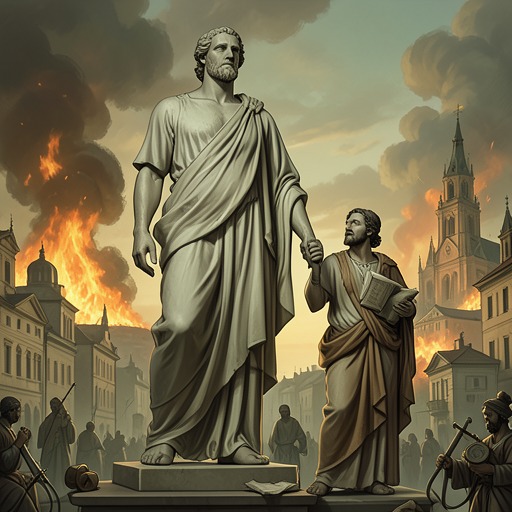
Quo VadisChristianity is the moral and spiritual force against which Vinicius measures his Roman assumptions in Quo Vadis. Its decisive significance lies in the gap between profession and practice: the Christians do not answer violence with vengeance, and their mercy changes the wounded patrician before he can fully explain or accept their faith. Through Lygia, Peter, and Paul of Tarsus, Christianity comes to mean a demanding way of life—not simply reverence for Christ, but love enacted, truthfulness, fidelity, and hope that death does not end life.
Teaching Made Visible in Mercy
When Vinicius lies wounded among the Christians, Crispus explains why they have tended him: Christ commanded them to love even their enemies. They have dressed his wounds and will pray for his recovery, although his pursuit of Lygia has deprived her of guardians and left the Christians without a roof. Their kindness is not presented as approval of his actions. Crispus names the harm he has caused even as he refuses to repay it in kind, making mercy a practiced obligation rather than a passive sentiment.
The Christians also explain that they cannot remain to watch over Vinicius. His companion has been killed, he is powerful among his own people, and the anger of the city prefect may fall on those who sheltered him. Their departure therefore carries a cost and a danger: they must protect themselves from prosecution even after caring for the man whose actions have brought them trouble. The scene gives Christianity a distinctive ethical shape—compassion does not erase consequences, but it changes the response to injury.
Vinicius cannot readily understand this distinction. He reasons that the Christians had both the power and, by Roman standards, the right to kill Chilo for his personal wrongs. He searches for an alternative explanation, wondering whether a sacred day or some prohibition against killing might account for their restraint. Yet the words of forgiveness resist that rationalization: Glaucus has forgiven Chilo, and the Christians’ conduct gives practical meaning to the teaching that an offender should be forgiven repeatedly. Vinicius has heard the doctrine before; what unsettles him is seeing it acted upon when vengeance would seem socially justified.
A Different Measure of Happiness and Death
Lygia articulates the faith’s answer to suffering through a contrast between Christian and Roman understandings of life. Christians, she tells Vinicius, experience separation, pain, and suffering, but faith can turn them toward joy; death, which he regards as life’s end, is for them a passage from a lower happiness to a higher and eternal one. She connects that hope to an ethic: Christianity commands love for enemies, forbids falsehood, and purifies the soul of hatred. Asked whether she is happy, she answers that a person who confesses Christ cannot be unhappy.
Her assurance does not persuade Vinicius by argument alone. He has already encountered Christian teaching at Ostrianum and seen the Christians’ treatment of himself and Chilo, but he describes their deeds as almost too extraordinary to trust. Lygia’s explanation supplies a framework for what he has witnessed: the faith’s promise of enduring happiness is inseparable from the conduct that makes mercy and release from hatred possible. Christianity offers neither a denial that suffering occurs nor an assurance that believers will avoid it; instead, it changes the meaning attached to suffering and death.
Love Against Roman Order
As he recovers, Vinicius recognizes that the Christians’ religion reaches beyond individual kindness. He sees it as capable of changing people “to their foundations” and imagines that, if its love and charity could take hold throughout the world, a different age might follow. But this possibility frightens him. He believes Roman peace, supremacy, and social distinctions form a sound order; a religion that treats conquered peoples as equal appears to threaten Rome’s dominion and the hierarchy on which his patrician identity depends. He can admire Christianity’s moral effects and still regard its implications as impossible to live by.
This conflict also shapes his understanding of Lygia’s flight. In a letter to Petronius, he struggles to reconcile her apparent affection with her decision to leave Miriam’s dwelling. Paul of Tarsus has suggested that clearer understanding will allow Vinicius to see why she acted as she did. Vinicius begins to suspect that Lygia fled not because she felt nothing for him, but because she could not share a life bound to Roman society’s gods and crimes. His offer to honor Christ as one more deity does not resolve the problem: he gradually understands that Christianity asks not merely for an altar or a profession of belief, but for a life governed by its teachings.
Vinicius Encounters the Community
The change becomes public when Vinicius goes to Miriam’s house and greets Peter, Paul of Tarsus, Glaucus, and Crispus in the name of Christ. He tells them that he knows where Lygia is and could seize her: Caesar has given him a right to her, and he has nearly five hundred slaves at his houses in the city. He nevertheless says he will not use that power. The restraint is a concrete measure of what the Christians’ example has already changed in him, though he is not yet a Christian.
Vinicius asks Peter and Paul to give Lygia to him as his wife and offers to learn the religion rather than pretend that he has already received it. He admits that, before knowing the Christians, he would have taken her by force. Their virtue and faith, he says, have altered something in his soul: he now knows pity and can no longer treat his servants with the same iron hand. He also confesses that his former pursuit of pleasure no longer satisfies him. His account makes conversion a matter of conduct and self-understanding, not simply assent to a doctrine.
Still, Vinicius remains uncertain. He asks whether Christianity leaves room for life, joy, happiness, law, authority, and Roman rule, and whether its followers are enemies of life. Peter answers his broad demand with a concise statement: “We bring love.” Paul adds that speech, even in the tongues of men and angels, is empty without love. Peter then blesses Vinicius and his love for Lygia. The exchange answers the tribune’s questions by placing love at the center of Christian life, while the blessing joins spiritual teaching to the human relationship that first drew him toward the community.
Vinicius says he feels happy among them and asks them to continue teaching him at Antium, where he must accompany Nero. He offers his villa as a place for their gathering and points out that the imperial court itself contains Christians, including Acte and some soldiers. Peter cannot go, but Paul agrees to accompany the tribune. The proposed journey brings Christian teaching toward Caesar’s circle, while showing that the community’s concern for a new convert can draw its members beyond their immediate refuge.
Belief, Baptism, and the Meaning of Conversion
When Vinicius later meets Lygia, he explains that Paul has convinced him that God came into the world and gave himself to be crucified for its salvation. He believes in Christ’s resurrection because the witnesses, in his judgment, are people who love truth and saw him after death. Peter, who first blessed him, is to baptize him; Vinicius has delayed baptism so that Lygia can witness it and Pomponia can stand as his godmother. His confession marks a distinction between believing and formally entering the community, while showing that he now understands faith as more than an accommodation to Lygia’s devotion.
He recalls that he once feared Christianity because he thought it would take Lygia from him and deny wisdom, beauty, and happiness. He now argues that its teaching calls him to prefer truth to falsehood, love to hatred, virtue to crime, fidelity to infidelity, and mercy to vengeance. Unlike abstract appeals to virtue, he says, Christianity makes the heart just, pure, and faithful. Its promise of eternal life gives those values a ground beyond advantage: he expects life and happiness after death, and imagines finding Lygia there as well.
The most telling evidence of change is the contrast Vinicius draws between love and possession. He says he has never been so happy, and recognizes that he could not have won Lygia’s declaration of love by exercising Rome’s power over her. Christianity has not merely supplied him with a new religious identity; it has altered his conception of what love can be. Its narrative force lies in this reversal: the faith he first fears as an enemy of his world becomes the condition under which a freely returned love, moral self-restraint, and hope beyond death can be imagined.